The bitterbal doctrine
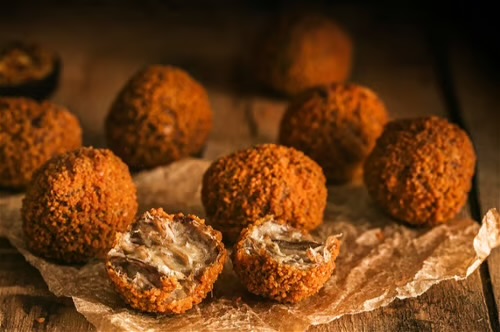
A bitterbal is a small round snack: thick beef ragout, rolled in breadcrumbs and deep-fried until the outside crunches and the inside turns to molten lava. It comes with a dish of mustard and usually arrives with a cold beer on a terrace on the Markt.
The name has nothing to do with the taste. The balls belonged to the bittergarnituur, the snacks served with a “bittertje”, a glass of herbal jenever liqueur.
Mustard is mandatory
Every portion comes with a dish of mustard. Ketchup will be politely but firmly taken away.
Respect the lava
The ragout inside stays hot long after the outside feels safe. Bite once, let the steam out, then wait.
Share fairly
Portions come in sixes or eights. Whoever takes the last bitterbal orders the next round.
Respect the kroket
The bitterbal’s big brother: the same ragout, but long and sausage-shaped. Eat it on a soft bun with plenty of mustard (a broodje kroket), or straight out of a vending-machine wall. Bitterballen at the bar, kroketten at lunch. That’s the law.
Finnish sauna in Delft 🇫🇮🔥
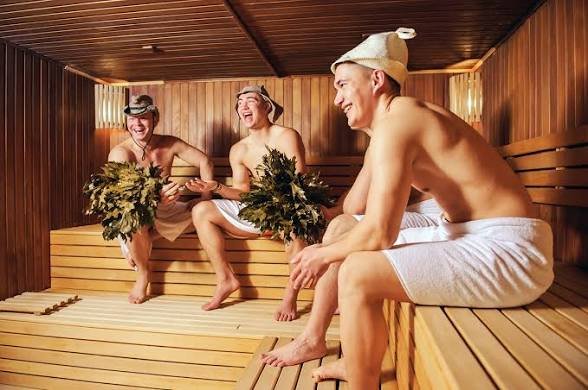
Delft is getting hotter. Soon a real Finnish sauna opens in the city: wooden benches, a wood-fired stove and proper löyly, the wave of steam when water hits the hot stones. And in true Finnish style, the staff will work topless.
The real thing
No spa-lite: an authentic Finnish sauna, hot, wooden and simple. Sit, sweat, breathe, repeat.
Hot, then cold
The Finnish ritual: heat up in the sauna, cool down fast, rest, and go again. Delft has plenty of canals, but we’ll provide a cold plunge instead.
Topless staff
Our staff work the Finnish way: topless. Relaxed, natural and nothing more than that. Adults only (18+). Respect for staff and guests is the number one house rule.
Afterwards
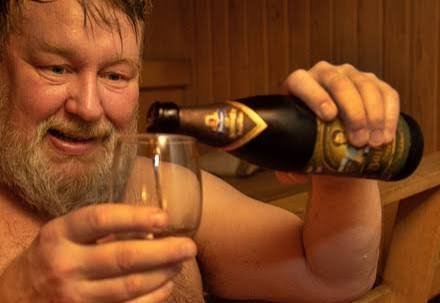
After the sauna, a cold beer and a plate of bitterballen. Finland meets Delft. Some call it an afzakkertje, others call it heaven.
Opening date and address coming soon
Want to be the first to know? Keep an eye on this page.
Pubs: where the greatness happens
Delft is a small student city with a lot of bars per square metre. These are our campaign offices. Bitterballen are available at most of them.
Locus Publicus
Brabantse Turfmarkt 67. A small, packed brown café with more than 200 beers, most of them Belgian. Their house rule: never just order “a beer”.
De Liefhebber
Markt 20. On the Markt, specialising in Dutch jenevers, gins and whiskies and local craft beer, with vegan versions of the classic snacks. Order a bittertje with your bitterballen.
Vanouds De Twee Kruikjes
Molslaan 5. “The Two Little Jugs” calls itself the smallest but cutest pub in the historic centre. A real old-fashioned Delft brown café: squeeze in, order a biertje and you’ll be talking to the whole bar within minutes.
Delfts Brouwhuis
Hippolytusbuurt 43. A city brewery with a restaurant and beer garden, 20 taps of “echt Dellufs” beer, and a view of the brewer at work. While converting the building, the owners found a medieval cellar from around 1300, with shards of an old beer mug. Beer may have been brewed on this spot for some 700 years.
Doerak
Vrouwjuttenland 17. A beer café on a canal corner, with a terrace by the water, a dozen taps and a long list of bottles.
Café de Oude Jan
Heilige Geestkerkhof 4. Right next to the Oude Kerk. Archaeologists found the remains of a medieval brewery under this square.
Kobus Kuch
Beestenmarkt 1. Calls itself the cosiest café in Delft and has been around since 1988. Perfect for the terrace on the Beestenmarkt.
Het Klooster
Vlamingstraat 2. A beer bar in a corner building with a view of the leaning tower from the terrace (see plan point 02).
Café de Wijnhaven
Wijnhaven 22. A busy, cosy café on the old Wijnhaven canal, open every day from 11:00 until 01:00. The café is downstairs; upstairs is a restaurant for dinner. The menu runs from curry soup to gnocchi, and it’s at its liveliest on a Friday night.
Belvédère
Beestenmarkt 8. Belgisch Bier Café Belvédère: a slice of Belgium on the corner of the Beestenmarkt, one of the prettiest squares in the country. Classic Belgian beers on tap and in bottles, Belgian dishes such as mussels, and a covered, heated terrace for winter.
Café de Beierd
Burgwal 18. The tourist board calls it a local secret. Ask the staff about the five daily snacks, order the borrelplank De Beierd, and pair it with a good wine or a special beer. It’s also good value for lunch.
’t Postkantoor
Hippolytusbuurt 14. Delft’s old post office (1890 to 2005), now a playful café-restaurant with a colourful, slightly Pippi Longstocking-style interior. In summer you can have your drink on a swing or a bed in the garden.
Café De Ruif
Kerkstraat 22-24. Eetcafé De Ruif sits near the canal in the old town. The food is hearty (people rave about the spareribs) and the evenings run late: it’s busiest around eleven on a Friday, and people tend to stay for a good three hours.
’t Proeflokaal
Gasthuislaan 36. A friendly beer café on the edge of the old town, with everything from pilsner on tap to stouts in cans. It opens in the afternoon and stays open late, with live music nights now and then.
De Koperen Kat
Schieweg 15. Delft’s oldest city brewery, brewing every day on the Schie near the historic Kruithuis. There are 19 special beers, including one called Delftse Donderslag (see plan point 05), plus a tasting room with snacks. In the 15th century Delft had around 200 breweries; De Koperen Kat carries on the tradition.
The last round: an official glossary
Nobody in Delft says “one more drink”. A great city needs at least four words for it.
Een slaapmutsje
“A little sleeping cap.” The nightcap: one last glass to send you off to bed.
Een afzakkertje
From afzakken, to wind down or drift off. The drink that brings the evening gently in to land.
Een puntje
“A little full stop.” The dot at the end of the evening’s sentence. The puntje op de i.
Een neerzettertje
“A little set-it-down.” The one you have after everything else, to settle it all before you go.
Campaign promise: all four are allowed in one evening. Just not on a bike.
Restaurants: dinner is served
Bitterballen are great, but a campaign can’t live on snacks alone. From weigh house to wine bar, these are the best places in the centre of Delft to sit down for a proper meal. Booking ahead is smart, especially at weekends.
De Waag
Markt 11. A café-restaurant in the old weigh house behind the Stadhuis. Eat lunch beneath a huge pair of scales from 1647, and catch a free gig when it turns into a music café.
Le Vieux Jean
Heilige Geestkerkhof 3. A classic French bistro right by the Oude Kerk, with a Michelin Bib Gourmand in both 2024 and 2025 and a wine list sixteen pages long.
Stads-Koffyhuis
Oude Delft 133. Delft’s favourite lunch spot on the prettiest canal. Famous for award-winning sandwiches and big Dutch pancakes. In summer you can eat on the boat moored out front.
Lalou
City centre. A French brasserie and wine bar with more than 750 wines on the list and a Michelin Plate in 2025.
Restaurant Azurite
City centre. Modern French fine dining with a serious cellar of over 12,000 bottles. The place for a big night out.
Novaela
Bagijnhof 118. Tasting menus in a quiet corner of the old town. Sit back and let the kitchen decide.
Kruydt
Paardenmarkt. Tasting menus on the square where the old gunpowder house once stood. Explosive flavours, safely this time.
GRK & ZO
Verwersdijk 32. Greek and Mediterranean dishes in a stylish black-and-colour interior, served with plenty of elegance.
Groots Café HANNO
Doelenplein 7. A culinary trip around the world without leaving Delft. Order a few dishes to share and be surprised.
Spijshuis De Dis
Beestenmarkt 36. Classic Dutch cooking on Delft’s prettiest square. Famous for fresh fish and soups served in a bread bowl.
Bij Best
Vrouwjuttenland 22. All-day breakfast, grilled sandwiches and good coffee. Best of all: you can eat on their terrace boat.
Het Boterhuis
Behind the Stadhuis. A grand café-diner with good beer and a great location in the heart of the old town.
Rossio
Oude Delft 78. Spanish and Portuguese flavours along the oldest canal in town. Usually full, so book ahead.
Il Tartufo
Minderbroerstraat 2. A little piece of Italy: an Italian deli with fresh pasta, cheeses and some of the best sandwiches in town. Grab one and eat it by the canal.
De Delf
Oude Delft. Named after the canal it sits on: the Delf, the ditch that gave the whole city its name.
La Fontanella
Near the Nieuwe Kerk. The oldest Italian restaurant in Delft, open since 1974. Fresh pizza and pasta, and in summer a terrace boat with a view of the Nieuwe Kerk.
Il Peperoncino
Verwersdijk 124. A family-run Italian restaurant with fresh ingredients and authentic dishes. In summer, linger on their terrace boat on the Verwersdijk canal.
San Marco
Brabantse Turfmarkt 23. Naples-style pizza from a real wood-fired oven, handmade ravioli and dishes made with imported Italian ingredients. Watch the chefs at work in the open kitchen. Book ahead, it’s popular.
Pizzeria Stromboli
Markt 6-10a. Italian pizza right on the Markt, next to the Stadhuis.
Pizza Beppe
Markt. Real Neapolitan pizza: handmade dough, San Marzano tomatoes from the Vesuvius region and Fior di Latte. Beppe was the first in the Netherlands recognised by the Neapolitan pizza association AVPN.
Fratelli
Beestenmarkt. Homemade Italian dishes on the lively Beestenmarkt. Try the ravioli.
Pavarotti
Old station building. A cosy Italian restaurant in Delft’s old railway station. Perfect when you arrive by train.
Redjeki
Choorstraat 50. Indonesian and Indo-Dutch (Indisch) cooking in the old town. Order a rijsttafel and share.
De Botanie
Choorstraat 24. A restaurant with a love for botany, full of plants and natural materials, with a hidden garden out back. Open all day: freshly roasted coffee, brunch, sharing plates for dinner and cocktails inspired by The Drunken Botanist. Plenty of vegan options too.
Snackbars: frietje met?
No campaign day is complete without a cone of fries. These are the best places in the centre of Delft for patat, a kroket or a frikandel.
House of Frites
Jacob Gerritstraat 4. One of the best-rated snackbars in the country. Organic fries cut just right, plus vegan bitterballen and krokets next to the classics. Locals swear by their patatje oorlog. House rule: bringing your own sauce is not allowed. Theirs is better anyway.
Bram Ladage
Paradijspoort 8. The Rotterdam fries legend, going since 1967 when Bram started selling fresh fries at the market. Potatoes are delivered fresh and cut by hand every day. Order a well-filled cone with a big dollop of mayo.
How to order like a local
Patatje met
Fries with mayonnaise. Just say “met” and they know. Ask for “zonder” if you want them plain.
Patatje oorlog
“War fries”: in Delft that means peanut sauce, mayonnaise and chopped raw onion. Messy, glorious, and some places call it “patat feest” instead.
Kroket
The bitterbal’s big brother, crispy outside, molten ragout inside. On a bun with mustard it’s a broodje kroket. See the bitterbal doctrine, §4.
Frikandel
A skinless deep-fried sausage. Order it “speciaal” for mayo, curry ketchup and onions on top.
Kaassoufflé
Melted cheese in a crispy pastry jacket. The vegetarian’s best friend at the snackbar. Careful: it’s just as hot as a bitterbal.
Coffee & sweets
Every campaign runs on coffee. And apple pie. And chocolate. No pubs, no lunch menus: just the sweetest spots in the centre of Delft for a koffie met wat lekkers.
Neef Rob
Choorstraat 34. Delft’s espresso and tea bar, once crowned the best coffee spot in Delft and surroundings, and still living up to it. Around 18 kinds of coffee, 120 loose-leaf teas and chocolate to go with it. Say hi to your cousin Rob.
De Lelie
Voorstraat 10. One of the top chocolatiers in the Netherlands, making around 17,000 kilos of handmade chocolate a year. Their ice cream is legendary too: try a scoop of “Delftenaar”, with white chocolate, hazelnut praliné and almonds.
De Lelie Gelaterie
Gasthuislaan 54. De Lelie’s second shop sells ice cream all year round, with new flavours every month. On summer evenings the queue is part of the fun.
Bombina
Hippolytusbuurt. Fresh pastries and sweet treats made every morning by brother Ioannis and sister Konstantina. Holiday feeling included.
Luciano
Markt. Italian gelato right on the Markt, with dozens of flavours. Choosing is the hard part.
Wafels en Zoenen
Markt 37B. Belgian waffles and chocolate kisses right on the Markt. Pile on the toppings (Biscoff and caramel, or apple and cinnamon) and they have gluten-free waffles too. The name says it all: waffles and kisses. Delft-approved.
Thursday market
Markt. The real deal: a fresh, warm stroopwafel straight from the stall at the Thursday market. Eat it on the spot, while the syrup is still runny.
Bakers: rise and shine
Great days in Delft start early, with warm bread, a sticky pastry and a baker who was up long before you.
Boulangerie Michel
Oude Kerkstraat 4. A little piece of France hidden behind the Oude Kerk. Go for the almond croissant; stay for soup or quiche.
Let’s Bake a Story
Wijnhaven 5. “The place where great stories are baked.” Baked fresh every day: sourdough bread, croissants, brownies and pastries, plus coffee to go with beans from Miss Morrison. Birthday cakes, wedding cakes and sweet tables to order, and the Flying Pastry box sends brownies and blondies by post.
Stadsbakkerij De Diamanten Ring
Choorstraat 9. The city bakery, in a monumental building that was once the inn "De Diamant". Legend says William of Orange's assassin slept here the night before. Today it's all bread, pastries and cream cakes, baked by hand every morning. No seats, so take it to the canal.
Bakkerij Van Maanen
Hippolytusbuurt 3. Bread, plus cookbooks, gifts and a wall of peanut butter. Breakfast and lunch too, with Delft Blue pottery from Heinen in the same shop. Open every day.
Promises we can (mostly) keep
Every great campaign needs a platform. Ours is made of hand-painted earthenware, glazed twice.
Bring Vermeer home
Johannes Vermeer was born, worked and buried in Delft. Not one of his paintings hangs here today. We’d like to borrow a few back, please.
Keep the lean
The Oude Kerk tower leans about two metres off true. Pisa gets the postcards; we get the character. No straightening. Ever.
Blue everything
Royal Delft has been at it since 1653. We propose Delft Blue bike racks, bus shelters and, eventually, clouds.
Bikes over everything
More bike parking at the station. Fewer bikes in the canals. A bold vision.
No gunpowder downtown
In 1654 a powder magazine blew up and flattened a chunk of the city. Lesson learned. Fireworks stay on New Year’s Eve.
Brains & bitterballen
TU Delft builds the future; the Markt serves the bitterballen. Funding for both is non-negotiable.
Slow down the fatbikes
Fat tyres, thin patience. An e-bike should help you pedal up to 25 km/h, not turn the Markt into a racetrack. Kids of eleven can simply pedal, like everyone else.
Divide and rule? Not in Delft.
That’s not how we do things here. Delft is a city of students and old Delftenaren, of locals and tourists, of people from all over the world. And at the bar, on the terrace and on this website, we have one simple rule: we don’t talk politics. This campaign has only one party, and it’s a borrel. With bitterballen, of course.
One Delft
Born here, studying here, or just here for the day: you’re welcome. Nobody asks where you’re from, only what you’re drinking.
No politics at the table
Leave the debates at home. At the pub we’re not left or right, just thirsty. Nothing divides a table faster than politics, and nothing brings it together faster than a fresh round of bitterballen.
What we do talk about
The weather (always). Whose round it is. Whether the Oude Kerk is leaning more than last year. The best spot on the Markt. And of course: mustard or no mustard? (Mustard. Always mustard.)
“Make Delft Great Again” is a wink, not a political statement. The only thing we campaign for is gezelligheid.
You’ll own nothing and you’ll be happy.
Except your bike. And your bitterballen.
Your bike
Yours, and yours alone. Locked to an actual bike rack, preferably twice. Bell optional, lights not.
Your bitterballen
Eight in a portion, and every single one of them is yours. Sharing is a sign of true friendship, not an obligation.
The next round
That one you don’t own. You owe it. Proost!
The case for “again”
Delft gets its city rights. The canals are dug, the brewers move in, and things are looking up.
William of Orange, “Father of the Fatherland”, is assassinated in the Prinsenhof. The bullet holes are still in the wall.
Johannes Vermeer is born. He spends his whole life here, painting quiet rooms full of Delft light.
De Porceleyne Fles opens: the factory that becomes Royal Delft, still painting blue by hand today.
The Delft Thunderclap. A gunpowder store explodes and wrecks part of the city. (See plan point 05.)
The Royal Academy opens. It grows into TU Delft, the country’s largest technical university.
The Nieuwe Kerk still holds the royal burial vault, the Markt still has the best terraces, and the tiles are still blue.
Stories of Delft
Every great city has its legends. These are all true. More or less.
A city named after a ditch
Around 1100, people dug a drainage canal through the marshes, using an old creek. They called it the Delf, from delven, “to dig”. That ditch is now the Oude Delft, the city’s oldest canal, and it gave the whole city its name.
The bullet holes in the Prinsenhof
In 1584 William of Orange was shot on the stairs of his home in the Prinsenhof. The holes in the wall are still there. The man who led the Dutch revolt is buried in the Nieuwe Kerk, and the royal family has been buried there ever since.
The painter and the goldfinch
Carel Fabritius, one of Rembrandt’s most talented pupils, moved to Delft in 1650. On 12 October 1654 the Kruithuis, a gunpowder store, exploded and destroyed his street and studio. He was pulled from the ruins but died soon after, aged 32. One of his last paintings, a tiny goldfinch, survived and now hangs in the Mauritshuis. Today the Paardenmarkt stands where the Kruithuis was.
Two boys born in 1632
Vermeer and Antoni van Leeuwenhoek, the father of microbiology, were baptised a few days apart and appear on the same page of the church register. Both became masters of light: one with paint, the other with tiny homemade lenses. When Vermeer died in debt, the city appointed Van Leeuwenhoek to sort out his estate. Were they friends? Nobody knows for sure.
Escape in a book chest
Hugo de Groot (Grotius), born in Delft in 1583, became one of the founders of international law. When he was locked up in Loevestein Castle, he escaped in 1621 hidden in a chest of books, a plan dreamed up by his wife Maria (see the power women). His statue now stands on the Markt, in front of the Nieuwe Kerk.
Beer before blue
Long before the pottery, Delft brewed beer. In the 15th century the city had around two hundred breweries, and its beer, made with peat water, was exported across the Low Countries. When the brewing trade declined, pottery makers moved into the empty breweries. Delft Blue literally grew up in old beer halls.
The bridge from Venice (or not)
On the Voorstraat stands the Visbrug, an ornate iron footbridge that looks like it floated over from Venice. The legend: a Delft brewer once visited Venice, was shocked by the beer and taught the Venetians how to brew properly. As thanks, they gave him a bridge, with one end at his front door. The truth: it was built in 1869 in a Venetian-looking style, and it’s now a national monument. We prefer the legend.
60,000 slices a year
Kobus Kuch on the Beestenmarkt sells around 60,000 slices of apple pie a year. A visit to Delft isn’t complete without one. That’s a campaign promise too.
The power women of Delft
History books love the men of Delft: Vermeer, Van Leeuwenhoek, William of Orange. But the city was also run, painted, fired in the kiln and engineered by remarkable women.
Louise de Coligny
William of Orange’s fourth wife had already lost her father and her first husband in the St Bartholomew’s Day Massacre of 1572. In 1584 she lost William too, in their own home in the Prinsenhof. She didn’t break: she raised their son Frederick Henry, who went on to become one of the Republic’s great stadtholders. She also kept a famous cabinet of 285 pieces of porcelain.
The women behind Vermeer
Maria Thins, Vermeer’s wealthy mother-in-law, took the young couple into her house on the Oude Langendijk, where he painted his masterpieces. His wife Catharina Bolnes raised a huge family. After his death she fought to keep his painting The Art of Painting out of the creditors’ hands.
The bread rebels of 1616
On 1 August 1616 Delft put a new tax on grain, and bread got more expensive. The women of Delft said no. At a mill they chased off the tax collector, then marched to the Markt behind an apron tied to a stick, beating a kettle and a children’s drum to call everyone out. The next day the crowd stormed the Stadhuis and the tax houses, and the city gave in: the tax was scrapped. Then came the backlash. Troops arrived, 64 people were arrested, and eleven were banished from the country on pain of death. Three of them were women: Reym Isacx, who sold small beer, Dirckje de Borre and Leonora, wife of Longeville. Banished for standing up for cheaper bread.
Barbara Rotteveel
In 1671 she passed the master’s test of the guild of St Luke, a rare honour for a woman. She then owned and ran the Delftware factory De Drie Klokken (The Three Bells) for 36 years, joining forces with other potters whenever business called for it.
The ladies of Delft Blue
Researchers have found 56 women who owned, co-owned or managed Delftware factories in the 17th century. Johanna van der Heul, for example, ran De Grieksche A (The Greek A) from 1703 to 1722. Delft Blue was very much women’s work too.
Maria van Reigersberch
The real brains behind the most famous escape in Dutch history. When her husband, Delft-born Hugo de Groot, was locked up for life in Loevestein Castle, she followed him there. In 1621 she and their maid Elsje van Houweningen came up with the plan: hide Hugo in the chest that carried his books in and out. Hugo got the fame, Maria stayed behind in the castle.
Marie Bes
In 1900 she became the first female student at the Polytechnic School in Delft. In 1904 she graduated in chemical technology alongside fourteen men, making her the first woman engineer in the Netherlands. Later she was one of the first three women on Delft’s city council.
Toos Korvezee
A chemist who became the very first female professor at the Technische Hogeschool Delft, now TU Delft. Generations of women engineers followed in her footsteps, and today’s TU Delft is a lot less of a men’s club because of pioneers like her.
Stanny Koopman
In June 1921 she became the first woman to graduate in mechanical engineering in Delft. Machines, engines, turbines: a world of men, until she walked in.
Jo van Leeuwen
A physicist trained by the famous Lorentz, she came to work in Delft in 1920. It took until 1947 before she became the first female lector in Delft. Talent, patience and a very long wait.
Postcards from Delft
Six old buildings that make the skyline, hand-drawn in Delft Blue.
Do you speak Nederlands?
Twelve phrases to survive a night out in Delft. Don’t worry: the Dutch will happily switch to English. But try first, it’s much more gezellig.
Hoi!
Hi! The friendliest word in Dutch. Use it with everyone.
Dank je wel
Thank you. Add a smile and you’re halfway Dutch.
Gezellig
Cosy, convivial, warm, fun. The most Dutch word there is, and it has no real translation.
Lekker
Tasty. Also nice, good, great. Bitterballen are lekker. So is the weather, sometimes.
Een biertje, alstublieft
A beer, please. The single most useful sentence on this website.
Proost!
Cheers! Look people in the eye when you clink glasses.
Nog eentje?
One more? Danger: see the glossary of the last round.
Mag ik de rekening?
Can I have the bill? Usually you have to ask for it.
Waar is mijn fiets?
Where is my bike? Said by everyone in Delft, every day, outside the station.
Doe normaal
Act normal. The national motto, more or less.
Jammer!
What a pity! For when the bitterballen are sold out.
Ik spreek een beetje Nederlands
I speak a little Dutch. Say this and watch someone switch to English.
The ultimate test: the Dutch G
The Dutch g and ch sound like clearing your throat, gently. Practise on these, in order of difficulty:
Tap 🔊 to hear it spoken in Dutch.
Greatness, quantified
Delft loves dogs
Delft is a very dog-friendly city. Dogs come along to the café, lie under the table on the terrace, nap next to their owner on a canal-side bench and sniff their way across the Markt. And the city’s most famous resident owed his life to one.
The dog who saved the Prince
In 1572 Spanish soldiers made a night raid on William of Orange’s camp near Mons. According to the story, his little dog woke him by barking and scratching, just in time to escape. From then on he always kept a dog by his side. In many portraits, and on his tomb in the Nieuwe Kerk, there’s a dog at his feet.
Cafés & restaurants
In the Netherlands dogs are welcome in many cafés, inside as well as on the terrace, often with a bowl of water by the door. Café De Joffer on the Nieuwstraat, for example, welcomes dogs inside and on its terrace. It’s different everywhere, so look for a sticker at the door or just ask. Most places will say yes.
Parks & green space
The Delftse Hout, east of the centre, is the big favourite: woods, meadows and a lake for long walks. Mind the rules: from 1 April to 1 October dogs aren’t allowed on the sandy beach and the sunbathing lawn by the lake, and at the deer park dogs must stay on the lead during nesting season.
Squares, canals & benches
In the old town your dog can come everywhere with you: along the canals, across the Markt and the Beestenmarkt, and onto every terrace that allows it. The benches along the Oude Delft are perfect for a break while your dog watches the boats go by.
House rules
In built-up areas dogs must be on a lead, except in designated off-lead areas (losloopgebieden). Always pick up after your dog: bags in your pocket, please. And keep your dog away from children’s playgrounds and sandpits.
Tips for a dog day out
Bring water on warm days and watch out for hot cobblestones in summer. Bikes come from everywhere, so keep the lead short on narrow streets. End the walk on a terrace: you get a biertje, your dog gets a bowl of water. Everybody’s happy.
Rules about off-lead areas can change. Check the municipality of Delft’s website for the latest map before you let your dog run free.
Paint your own campaign tile
Every supporter gets a hand-painted tile. Well, a computer-painted one. Hit the button until you find one worthy of your kitchen wall.
“Lean in, like the Oude Kerk.”
Take the Delft pledge
Visiting Delft
Welkom! Delft is small enough to explore on foot and big enough to fill a whole weekend. Here’s everything a first-time visitor needs to know.
Getting here
Delft station is a five-minute walk from the centre. Trains to Rotterdam and The Hague leave about every ten minutes and take under 20 minutes. Amsterdam is about an hour away by direct train, and Schiphol Airport around 40 minutes.
Climb the Nieuwe Kerk
One ticket gets you into both the Nieuwe Kerk and the Oude Kerk. The tower climb needs a separate ticket and over 350 steps, some of them uneven. From the top, 85 metres up, you can see Rotterdam and The Hague on a clear day. Wear good shoes.
Royal Delft
The last original Delft Blue factory, still painting by hand since 1653. Watch the painters at work, see the museum, and buy the real thing. Genuine Delftware has a maker’s mark on the bottom, so look before you buy.
Vermeer Centrum
Housed in the old painters’ guild, where Vermeer himself was once head. You won’t find his original paintings here; they hang in museums around the world. But you will learn how he worked and see Delft through his eyes.
See it from the water
A canal boat tour is the best way to get your bearings. You glide under bridges and past 17th-century houses while the guide tells stories you won’t find in a guidebook.
Market day
Thursday is market day on the Markt: cheese, fish, flowers and fresh stroopwafels, the way locals shop. Come hungry.
How many tourists come to Delft?
A lot, for a city this size. Delft welcomes around 4 million visitors a year, about 1 million of them from abroad. That’s roughly 36 visitors for every resident. Most come for a day, and many come back. In 2025 visitor numbers were almost back to the record year 2019.
Tourist survival guide
- Bike paths are for bikes. Never stand or walk on them. You will hear a bell, and then you will hear Dutch.
- Look both ways, then look for bikes. They come from directions you didn’t know existed.
- Beware the fatbike. Those e-bikes with fat tyres are often ridden by kids, sometimes much too fast. In 2026 Delft police caught an 11-year-old doing 58 km/h on one. Look, then look again.
- Skip the tourist cafés on the Markt and head one street further. Our list of pubs is a good start.
- Find a hofje. These hidden courtyards behind doors and gates are some of the quietest spots in town.
- Stay the night. When the day-trippers leave, the canals light up and Delft becomes extra gezellig.
By horse and carriage through Delft 🐴
The most romantic way to see Delft? From the seat of a horse-drawn carriage. Sit back, listen to the hooves on the cobbles and let the old town roll past at walking pace, just like the wealthy merchants did centuries ago.
The route
- Markt Start between the Nieuwe Kerk and the Stadhuis.
- Oude Delft Along the city’s oldest canal, past grand merchant houses.
- Oude Kerk A slow pass by the leaning tower. Yes, it’s supposed to look like that.
- Prinsenhof Where William of Orange lived and died.
- Oostpoort The last city gate, with its white drawbridge.
- Back to the Markt Just in time for a bitterbal.
Good to know
- 🕰️ A sightseeing ride takes about 30 minutes; the guided tour about 90.
- 💍 Perfect for weddings, proposals and anniversaries.
- 🧣 In winter: blankets on board, hot chocolate afterwards.
- 🐴 The horses get regular breaks, water and plenty of pats.
- 🚲 Cyclists: give the carriage some room. The horse has right of way in our hearts.
🐎 Ride with Stalhouderij Delftse Hout
This livery stable runs several horse-drawn carriages through the old city centre, starting from the Markt or the coach park. Short on time? The sightseeing ride shows you the highlights in about half an hour. Want more? The 90-minute guided tour tells the story of William of Orange, the VOC, Vermeer and Hugo de Groot. Add a visit to a Delft Blue pottery or a museum, or dress up in 17th-century style and ride like a true Golden Age merchant.
William of Orange and the murder in the Prinsenhof
Willem van Oranje (1533–1584), also called William the Silent, led the Dutch Revolt against King Philip II of Spain. That revolt laid the foundation of the Netherlands. In 1572 he moved into the former Saint Agatha convent in Delft, now the Prinsenhof, partly because the city had the best fortifications in Holland.
Delft gave him shelter. It couldn’t keep him safe.
At a glance
- Victim: William of Orange, 51
- Date: 10 July 1584, early afternoon
- Place: the Prinsenhof, Delft
- Killer: Balthasar Gerards, a French Catholic
- Weapon: a pair of pistols
- Motive: a reward of 25,000 crowns from Philip II
Philip II declares William an outlaw and offers a large reward to anyone who kills him. Several attempts fail.
Balthasar Gerards, a devout Catholic and admirer of Philip, travels to the Netherlands. He presents himself to William’s household as a French nobleman and gains their trust.
Gerards complains he has no money. William, unsuspecting, has him given a sum for his needs. Gerards uses it to buy a pair of pistols from a soldier.
William has lunch in the Prinsenhof with a guest, Rombertus van Uylenburgh, the mayor of Leeuwarden. As he leaves the dining room and heads for the stairs to his study, Gerards steps out and shoots him at close range in the chest. William collapses at the foot of the stairs and dies almost immediately.
Tradition says he cried out in French: “My God, have mercy on my soul and on this poor people.” Historians doubt he had time to say anything, but the words have become part of Dutch history.
Gerards tries to flee but is caught almost at once. After a trial he is executed on the Markt, in a manner seen as extremely harsh even for the time.
The bullet holes
You can still see the bullet holes in the wall of the Prinsenhof, now a museum. In 2012 forensic researchers used a replica pistol to reconstruct where William and Gerards stood when the shots were fired.
Why Delft, not Breda?
The Nassau family vault was in Breda, but Breda was occupied by the Spanish. So William was buried in the Nieuwe Kerk in Delft. Since then, almost every member of the royal family has been laid to rest there.
The marble tomb
From 1614 Hendrick de Keyser built a grand marble mausoleum above the vault. At its corners stand female figures representing Freedom, Justice, Religion and Courage, the values William fought for.
A grim first
William is often called the first head of state in history to be killed with a handgun. A sad record for Delft to hold.
Want to see it for yourself? Visit Museum Prinsenhof and the Nieuwe Kerk. The Prinsenhof has been closed for renovation, so check the opening times before you go.
Our sponsors
Every great campaign needs great backers. These are the businesses that help make Delft great again.
 kantooronline.nlIT and cloud workspaces for businesses, from Delft
Become a sponsor
Sponsorship is for businesses only. Run a café, a shop or a company that loves Delft? Put your name on the campaign and get seen by every visitor to this site.
✉️ info@mdga.nl
Contact
Questions, tips for a pub we missed, a story about Delft, or interested in sponsoring? We’d love to hear from you.
Terms & Conditions
Terms & conditions for this website. Short, clear and with fewer clauses than the Oude Kerk has lean.
Read the terms
1. What this site is
“Make Delft Great Again” is a light-hearted, satirical tribute to the city of Delft. It is not a political campaign, and it is not affiliated with any political party, the municipality of Delft, Royal Delft or any of the businesses mentioned.
The “campaign promises”, pledges and slogans are jokes. Nobody is actually going to paint the clouds blue.
2. Using the site
You may visit, read and share this site free of charge. By using it, you agree to these terms. If you don’t agree, please close the page and go and have a bitterbal instead.
Don’t use the site for anything unlawful, and don’t try to disrupt or misuse it.
3. Accuracy of information
We put care into the historical stories and the list of pubs, but we can’t guarantee everything is complete or up to date. Cafés move, close or change their opening hours.
Always check with the venue itself before you set off on your pub crawl. Facts presented with a wink should be read with a wink.
4. Third-party businesses and links
Bars, cafés, breweries and other businesses are mentioned purely as a fan’s recommendation. Unless they are listed as a sponsor, they have not paid for it and have not endorsed this site. Their names and trademarks belong to their owners.
We are not responsible for the content of external websites, or for the service, prices or bitterballen temperature at any venue.
5. Alcohol
This site talks about beer, jenever and the occasional slaapmutsje. It is intended for adults. In the Netherlands you must be 18 or older to buy alcohol.
Drink responsibly, and never cycle or drive after drinking. Geen 18, geen alcohol.
6. Privacy and cookies
This site does not collect personal data. It uses no tracking, analytics or advertising cookies.
Your answers to the cookie notice, the pledge and the tile maker stay in your own browser and are never sent to us. Our only cookie is still the stroopwafel.
7. Copyright
The texts, illustrations and design of this site are the work of its makers. You may share links and short quotes, with credit. Please don’t copy the whole site or use it commercially without permission.
8. Liability
The site is provided “as is”, for fun and information. As far as the law allows, the makers are not liable for any damage resulting from using it, including burnt tongues from bitterballen eaten too quickly (see the bitterbal doctrine, §2).
9. Changes
We may update these terms at any time. The date at the top shows the latest version. Continuing to use the site after a change means you accept the new terms.
10. Applicable law and contact
These terms are governed by Dutch law. Any disputes will be handled by the competent court in the Netherlands.
Questions about the site? Get in touch via sivusto.blue.